Brief Encounter

Brief Encounter
St Pancras International Rail Station

Thursday, 22 April 2010

Strangers on a Train

22 April 2010

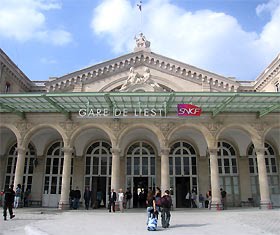
The trains travelling east leave from Gare de l’Est.  It’s a stone’s throw from Gare du Nord, the station I’m more familiar with.  Compared to its bigger neighbour, Gare de l’Est is a citadel of calmness and serenity – that is to say it’s very low key – except, of course, for the perennial CRS police sporting their submachine guns.  Eventually, I suppose they blend into the background – though I’m not sure they ever would for me.  Their presence and, even more, the acceptance of their presence, is a strong statement that is both in your face and subliminal.  But if you can ignore them and the many gypsy women who are the most tenacious beggars I have ever come across, then the atmosphere is almost tranquil.  So there’s the contradiction of Paris in a nutshell – on one hand, the CRS parade around train stations brandishing machine guns while, on the other, the gypsies are free to harass tourists and are not rounded up (as yet).  One could call this tolerance with an iron fist.  Perhaps it’s in the French nature to balance repression with anarchy.  Some find this sort of duality appealing; for others it’s a constant headache.

I arrived at the station early so I would have time to suss out the situation there as the first leg of my journey is divided into two: Paris to Stuttgart and then Stuttgart to Munich.  To make my connections takes rather fine timing as the Munich train is due to leave only fifteen minutes after my arrival in Stuttgart.  I was told this was not a problem here – though it’s something I would never attempt in England.  However, since there is only one night train to Budapest, I must be in Munich by 10 PM.  So, as a safety precaution, I booked the earlier train to Stuttgart. 
The TGV is full – every seat is taken, so reservations are essential.  I am seated next to a young German woman who has been teaching in Nancy and now is applying for a job as a supervising librarian back home.  She, of course, speaks English very well and is keen to practice on me as (she thinks) her English isn’t that good - at least not as good as her French and Spanish.  She tells me not to worry about connections as here the railways see to their customer’s welfare.  I’m not sure what that means but I am willing to accept her assurances.  And I feel quite relaxed until I find out that the train is going to be ten minutes late.  One of the problems is that even if I take the later train from Stuttgart, I have seat reservations on the first.  I asked my seat mate about that and she replies that in Germany seat reservations aren’t required.  (That’s all well and good, I thought, but considering how crowded the trains are, a seat reservation would come in handy rather than catch as catch could.)
The TGV is fast and comfortable – perhaps not quite as sleek as the Eurostar, but certainly adequate.  Time slips by as I chat with my train friend about her trip to New York that she took independently a few years ago.  Quite brave of you, I tell her.  She is pleased I think she’s brave.  I ask what her impressions of New York were.  She loved it, she said.  It was an exciting city and she walked every inch of it from Central Park to the Bowery.  But she was curious about America.  Americans she found quite friendly – much friendlier than either French or Germans.  I thought that a gross generalisation and told her that she was quite friendly and she was a German.  Besides though Americans could be quite friendly, it’s not often that you could have an intelligent conversation on the train with them.  She asked about Obama and why I thought he was more popular in Europe than in America and why so many people were opposed to national health care.  I said that Obama probably could win another election in the States, but not by much of a margin.  It just seems that he’s unpopular because the opposition to him is very loud.  About health care, I said that it is curious how people could so easily work in ways that were against their own interests.  But many Americans have a misguided notion of what liberty and freedom are all about – or at least have a curious and convoluted notion of those terms they brandy about like shibboleths to ward off the demons.  Finally, she asked why I decided to live in England.  I told her that ‘decided’ is hardly the word I would use – more ‘ended up’.  People rarely decide things like that; rather it’s a combination of circumstances, some in their control and others not.  
She told me that she had quit her job teaching in Nancy and was staking everything on getting the librarian’s post even though there were eight over people being interviewed.  The requirements were high.  She needed to be fluent in four European languages and know about library systems throughout the world.  So she asked me about the British Library and I told her what I knew about it.
I could see she was a bit nervous, having staked so much on this position.  And I told her, whatever happens it would probably be for the best.  I’m not a fatalist but where jobs are concerned, if you don’t get a position it’s often because it’s not right for you.  Whether she believe that or not, it seemed to ease her mind.  She left the train after Strasbourg; I shook her hand and wished her well.  I thought she was quite a remarkable young woman – self possessed yet intellectually open.  But strangers on a train are often open with each other – they share a moment and then they’re gone. 


Wednesday, 21 April 2010

The search for Vel d'hiv


21 April 2010

Sometimes you learn more by not finding something you’re looking for than by finding it  – at least right away.  I wanted to visit the Vel d’hiv monument which I read was located on the Quai de Grenelle near the Eiffel Tower.  The Vel d’hiv, charming as it sounds, was actually the indoor cycling stadium (its real name is Velodrome d’hiver) that was used by the Vichy government as a temporary collection point for the Jews who had been rounded up prior to being shipped off to the death camps.  What is striking about this roundup is that it was enacted entirely by the French gendarmerie under the supervision of the Vichy government and, in particular, the head of the national police - René Bousque.  It was only in 1993 that Francois Mitterrand (who maintained a friendship with Bousque to the bitter end) commissioned a monument to be built near the site.  However, it wasn’t till 1995 that an official apology was given by Jacques Chirac.  In his speech of contrition he said, “France, home of the Enlightenment and the Rights of Man, land of welcome and asylum, France committed that day the irreparable. Breaking its word, it delivered those it protected to their executioners.  More than that, it delivered its citizens to the gas chambers. 
I’m not much interested in visiting sites of gruesome murders.  I’ve never been to Auschwitz, Dachau or Buchenwald nor do I intend to.  However, I’m glad they’ve not been bulldozed and ploughed under like many state sponsored crimes have been.  But Vel d’hiv is different.  The Germans have gone through their period of atonement.  Every German school child was told what the Nazi state had done in their parents’ name.  France, however, allowed the mythology of their heroic resistance to flourish while laying flowers each year at Petain’s grave.  René Bousque prospered under the Fourth Republic and never spent a night in prison.  The vast majority of French know nothing of Vel d’hiv – even less today then back in the 60s when Marcel Ophuls filmed his extraordinary documentary, The Sorrow and the Pity.
Like Ophuls, whose father fled Paris early enough to save himself, my father fled Paris as well – though as an infant in his mother’s arms during the First World War.  But my maternal grandmother’s family remained and though I know that a few survived I haven’t yet been able to trace them.  Were any held at Vel d’hiv, with just the clothes on their back and a small valise of last minute items thrown together after that terrible knock at the door? Clutching the hands of their terrified children, no one knew what would come next.  Perhaps we can at least be thankful that no one knew. 
Deciding to visit the Vel d’hiv memorial was, in a way, connecting to those of my family who disappeared without a trace.  Whether some of them were taken to Vel d’hiv, I will never find out.  But the heart of their community was ripped out so part of them died there as well.

It’s not on the tourist map.  In fact the velodrome itself burned down years ago.  But the memorial was built near to the site and I had seen pictures of the sculpture which even in two dimensions was moving and inspirational (it was created by a Polish artist whose own parents had fortunately survived the roundup.)
I had no address – just the  Quai de Grenelle near the Champs de Mar station.  But an important monument like that, I felt, would be easy to find. 
After walking a while along the embankment and seeing nothing in the distance that evoked any idea of a memorial, I stopped to ask one of the gardeners trimming a hedge.  But he shook his head.  There was no Jewish memorial here, he said.  And looking at me intently he told me – nothing either for the Algerians.  He might have been Algerian, himself, by his appearance.  I wondered if Chirac had ever apologised to them. 
He was quite insistent, the gardener.  And he worked there.  Wouldn’t he know of a memorial if there was one?  Then I began to wonder whether it had been moved.  Perhaps my information was out of date. 
On the street level below, I asked a man who ran a tourist kiosk, but he waved me away with the flick of his hand.  Further I asked a quick sketch artist, showing him the information I had written on my notepad.  He shrugged but suggested I ask someone in the official looking building behind him.
A sign said it was a centre for the research and documentation of youth.  I could hardly guess what that meant but upon entry it appeared to be a European project to establish a range of programmes for teenagers.  It was empty except for two middle aged women who were staffing the information desk.  I went up to them and repeated what I had told the others.
One of the women seemed to understand.  She knew Vel d’hiv and told me that it doesn’t exist anymore.  But why? I asked.  Because it burned down.  Ah, yes.  That I know.  But it’s the memorial to the Vel d’hiv roundup I’m looking for.  Memorial? she said.  Is there a memorial?  As far as she knew there was only a plaque where the building once stood.  And once a year, yes, there is a memorial. 
I left in despair and half thought of calling it quits.  This was my last day in Paris and I didn’t want to spend it all on a wild memorial chase.
But walking further down the street, heading to the Bir Hakem metro stop, I saw in the distance what looked like the top of a sculpture with a man sketching it.  Mostly it was hidden from view because the embankment was raised and the entrance at this point was blocked by a fence erected by workmen who were repairing the wall. 
Gaining entry meant walking about a hundred yards further and then circling around till I could find the path that led along the Quai.  And then I found it.  In fact there was, at this particular point, a sign saying what it was.  The man who I had seen sketching, however, wasn’t drawing the sculpture.  He was just using the plinth as a base to sit upon while he drew the Eiffel Tower.

I stayed there a while communing with spirits past and then took some photos on my digital camera which I brought back to the ladies behind the desk at the youth centre.  It exists, I said.  And it is something that your youth should know of.

Tuesday, 20 April 2010


20 April 2010

Pelouse Autorisee says the sign.  I’m in the Luxembourg Gardens because 1) it’s a sunny day and 2) I read that some of the parks in Paris are now wifi enabled and I thought what a lovely idea it would be to sit in the Luxembourg Gardens and write.  Not that I couldn’t have done it the old fashioned way – and many times I have.  But somehow Mr Netbook who I purchased especially for this trip has an insistent idea that it has become my pen, notebook and sketchpad combined and I’m going along with it – for a while anyway. 
But first things first.  Am I not in Paris?  The same Paris where it is strictly forbidden to walk on the grass let alone sit?  As a young man I came here and enjoyed the anarchic game of sitting on the grass along with a multitude of Parisians of all ages until the gendarmes came and swept us off the pelouse, then they left and we all went back onto the grass until the next wave and so on.  It was one of those lovely cat and mouse games that Parisians were (and are) so proud of.  So along comes the Ken Livingstone of Paris, Bertrand Delanoe, who not only facilitates free internet access in the parks but also rescinds the law forbidding people to walk on the grass.  What fun is that?  (I had written an entire children’s book based on that premise.  Now what am I going to do?)     
Once it became legal to sit on the grass with a sign that declares it such everyone is doing it.  In fact entire classes of children are picnicking on the green.  So there’s hardly a space to sit.  When it was illegal, plenty of people sat on the grass but there was always room.  Now it’s legal and there is no room.  What does that tell us? 
Actually, I did find a little plot as lunch was coming to an end and the children were packed up and marched off, hand in hand, to indoor school.  So I found a place, sat down in the glorious sun, took out Mr Netbook and turned it on – or tried to turn it on, that is.  Nothing happened.   I think the gods are trying to tell me something.  But whatever it is, I cannot hear.  Bloody gods.  Bloody Monsieur Delanoe.  Bloody Mr. Netbook. 
Then I think, it serves me right.  Technology just gets in the way of good sense – and probably good writing.  What were pens and paper invented for anyway?  I will just go to a stationary shop and buy a proper notebook and that will be that.  Except I’m a little disappointed.  I bought the netbook especially for this trip and the whole idea was being multimedia and being able to combine words and photos and stuff into an amazing blog (whatever that is and why would anybody read it – but that’s another story, isn’t it?)  So, yes, I’m a little disappointed.  Why didn’t it turn on?  Maybe the battery is dead, I thought.  But I used it last night plugged in, so the battery should be fully charged.  It has now become an intriguing mystery.  The reason I bought this thing a month before leaving was to give myself a chance to break it in and get used to it  I read somewhere that if a computer is wonky you usually find out in a matter of days.  If you use it for a month without problems, it’s probably OK.  Except then there was the Hungarian who swabbed it at the train station when I left London – so he’s probably to blame.  Most likely there was something in that noxious stuff he spewed over the keyboard that created more problems than the full stop not working anymore unless you stomp down on the full stop key.  He was a sweet young man but sweet young men have been known to do terrible things  Now I’m so pissed off I decide to go back to my studio to see if Netbook works when it’s plugged in and if it’s only that the battery is wonky.  So I take the RER from Luxembourg to the Gare du Nord which is the quickest way home (a term I used advisedly). 
The RER is not the Metro – though within Paris you can use the same ticket.  It is somewhere between a commuter train running workers into the central city from the suburbs and a (supposedly) inner city rapid transit system.  The problem is that it doesn’t go many places and you have to know the entire system of tunnels and connecting labyrinths – otherwise it’s probably faster taking the Metro.  But the Luxembourg Gardens are only serviced by the RER so, if you’re going from the Gare du Nord, it makes sense to take it. 
However, it does not make sense taking the RER to the Gare du Nord unless you are a masochist or an intrepid explorer or both (usually they are one and the same).  I’ll tell you why.  But first …
Northwest Paris is black both in the British sense of everyone being black except blue eyed, blond(e)s and in the American sense of people whose immediate ancestors originated in Africa.  The RER line B is a fascinating social anthropological model of what’s happened to metropolitan Paris.  If you get on at Gare du Nord, you could probably count the number of pale white faces on one hand (I don’t include myself in that category).  But after Les Halles, you could count the number of black faces on the same hand and come up with change.  If you closed your eyes when you got on and then open them ten minutes later, the car you’re travelling on would be just as crowded but it would seem as if a digital trick had been played and a positive print had been turned into a negative (or the other way around). 
Paris has always been a city of immigrants.  If you’re travelling east to west, there’s not much further you could go without falling into the sea.  So, in that sense, France is like California.  Similar in its absorption but different.  You don’t really find black ghettos in Paris like you do in the inner cities of Los Angeles and San Francisco (the banlieu is different).  But there is a curious dividing line that seems to separate the French-French from the immigrant French speakers – though I’m not really sure what or who the French-French are (and France is probably not that sure either).  During WWII the Vichy government tried to make a distinction between the native French Jews and the immigrant Jews, suggesting that it was the later who should be rounded up and sent to the gas chambers.  But that broke down when it became unclear who actually was an immigrant and how far back you were prepared to travel.  Also a good many French-French are swarthy enough to fit into the British definition of ‘black’ so I think we’re getting into angels on pins territory here.  The point I’m making, I fear, was lost several sentences back.  It does have something to do with travelling on the RER, however.
I was going to say why it was more difficult taking line B back to Gare du Nord.  The reason has to do with the subterranean world of that particular station which ranks with Les Halles-Chatelet as the most infuriating rabbit warren in which to take a wrong turn this side of Lewis Carroll.  Following the signs that say ‘sortie’ does absolutely no good.  You must know exactly which sortie you want and if you don’t then you might as well sit down and wait for the CRS police armed with submachine guns to sweep you up in their net for at least then you might find the light of day without wearing out a pair of perfectly good shoes in the process.  I blithely figured one sortie was as good as another.  It isn’t.  And I know Paris – sort of.  But when I was eventually spewed out into the light of day, I had no idea in the world where I was.  Nor did anyone I asked.  Because no one spoke either French or English.  Wherever it was, Gare du Nord was nowhere in sight.  I must have walked for thirty minutes before I could find someone to ask the directions to Rue Magenta.  By then I was suffering from dehydration.  My feet were as swollen as they would have been after a forced march through the Sahara. 
I did make it back eventually to my cosy little nest that seemed very cosy indeed after this unwanted adventure. 
I plugged my netbook in and it worked.  So did the battery.  What do you say about that Monsieur Delanoe? 

Day 1 - Departure and Arrival

19 April 2010

The journey begins!  We are gliding out of St Pancras after a much easier boarding than I had expected since all the news has been about the many hundreds –if not thousands – of people who were stuck because of the cancellation of their flights due to the volcanic eruption in Iceland.  Of course the train is filled to capacity as any spare seats were quickly sold to those multitudes queued up outside the ticket office.  Even so, an announcement as we left said that as this was a direct train to Paris, anyone was free to exchange their seat for an empty one.  Since there are no empty seats in our carriage, that isn’t an option.  Never mind.  We’re off!  And as adventures go, this one had a rather shaky start as, over the last few days, the news had been full of frenzied travel stories – 150 or 200,000 Brits stuck around the world trying desperately to get back to their families, their jobs, or just because home was beckoning and they were tired.  Because chaos was in the air, that was the expectation.  But maybe the chaos had been played out in great orgiastic waves over the prior days so people were now resigned to their fate whatever it was

St Pancras was not the frantic scene of displaced travellers that I thought would await me.  In fact, there was a certain serenity upstairs where I had gone to photograph once more the Brief Encounter statue and to have a drink while I waited for my hour to cometh.  I had pictured (in my minds eye) starting this journey with a last drink at Carluccios where their outdoor seating juts up against the statue; but it was filled with their lunchtime crown.  Curiously, the pub on the other side of the statue, which had just as nice a view of the Eurostar boarding platform, was almost empty.  And since I only wanted a beer, it suited me fine.  So my last drink was at Betjeman’s, a fine writerly name for an unpretentious pub, rather than the trendy Carluccio’s which trades on its Italian ambiance and inflated prices while the Betjeman is laid-back British (no one bothers to come and take my order so I have to go inside to collect my drink from the bar).
After reading the rest of the Guardian (all about travel insanity and Nick Clegg – not that the two are related, though they might be) and taking some photos and film clips of the Eurostar platform just within reach but separated by a translucent barrier – I go back down to the main rotunda where the International waiting room is located.  I’m an hour early but it’s just as well to go inside as I’m somewhat fearful that the crowd will descend and I don’t want to be rushed or hurried.  Besides, I’ve printed out my ticket on the computer and there’s a wonky smudge that’s not exactly a barcode but seems to serve the same function. You’re supposed to scan it at the gate to allow entry – but I don’t believe it will work because it looks more like a pigeon dropping than a proper bar code sort of thing.  Fortunately there’s an attendant outside the automatic gate who takes it from me and scans it herself.  And, lo and behold, it does let me in.  Then on to the luggage inspection where I manage to lift the dinosaur of a bag (more on this later) up to the conveyor belt without rupturing anything organic.  Nothing whistles or buzzes when I go through the body scanner so I think I’m in the clear – but, no, I am waved aside by a pleasant young man who apologetically tells me that I’ll have to open my bag for inspection.  If he wasn’t so nice, I would have considered it a bad omen but he’s friendly and chatty and when he asks me where I’m headed and I tell him that Hungary is one of my destinations, he perks up saying that he’s from Hungary himself and have I been there before?  And when I say not since 1970, he informs me that things have changed somewhat since then.  He says this while swabbing my computer keyboard for traces of explosives (and I suddenly understand why I was pulled over because you’re supposed to take your computer out of your bag for the xray machine to scan and I hadn’t).  As those things go, it was fairly good natured and since I was so early there wasn’t any concern about delay.  The main thing was repacking my bag and making sure everything was put back inside – which is always difficult when there’s a queue of people behind.  It went smoothly though and then going through passport control I found myself in the waiting room and lo and behold there was a long counter with powerpoints and notices of free internet connection.  I was happy to take advantage of the opportunity and again unpacked my computer and hooked up to the St Pancras public wifi network only to find that, yes, I could get onto the Internet, and, yes, I could get into
Google mail but, no, I couldn’t open any of the messages even though I was still connected.   It was quite frustrating as I could see there was one from Olivier and I was waiting for his response to see if he would meet me at the station.  After several tries I gave up, thinking that since I hadn’t expected I’d be able to connect there really wasn’t any loss.  So, instead, I walked over to the waiting room café and ordered a beer.


As I said, it was an anticlimactic departure.  After all the hoopla of the  exploding volcano and the similar eruption in the  election campaign following the first debate when Nick Clegg suddenly became the British Obama, my leaving in a atmosphere where everyone else was trying to get home seemed like plunging into the eye of a tornado.  But now it’s happened I’m feeling quite relaxed about whatever lies in store.  I dust off my antennae to enable my sensors again.  There is a shift going on that has yet to be analyzed – if it ever will.  And I want to record this remarkable time – if not for posterity at least for myself. Whatever is happening, it’s making people reconsider the world they live in.  Everyone knows there is something unusual taking place, socially, economically, spiritually.  How this will affect people’s daily lives is not at all clear.  But they know change is upon them – that’s why they are so eager for it.  If they didn’t think it was happening or if they didn’t think it was possible, they would simply go on the way they did for it’s both easier and more comfortable to allow the status quo to continue even if it’s boring, even if it hurts.  But when change is in the air, you don’t need a weather reporter to say which way the wind blows.

There is very little to distinguish one side of the tunnel from the other -  the same flatness, the same scraggly trees, the same fields of hesitant green, the same concrete highways, the same boxy warehouses of corrugated steel.  But every once in a while on this side of the tunnel you see something Gallic - a church spire perhaps or a rustic farmhouse - but you have to look closely for we’re in the Eurozone of Sameocracy.  I want to see a Vache qui Rit; instead there’s just miles and miles of pylons and connecting wires to electrify this overcast world.

The train ride to Paris is smooth, quick and uneventful – more like a proper commuter run than the start of an International Adventure.  When Eurostar works well, it works very well.  When it doesn’t, there’s hell to pay.

We sail into Gare du Nord like a sleek successor to a glamorous coal-fired queen.  I let people off before me so I can descend without hurry, gracefully (if you can tug a dinosaur that way).  So I am the last one off to walk the very long platform that leads to the hurly-burly circus-like world of this outlandish terminus.  It’s an entry into delightful, head spinning anarchy after a quiet transition through the euro birth canal.  And in the distance I am pleased to see my old friend has come to greet me.    


Saturday, 17 April 2010


Steam – the grand old stations with great, arched ceilings reaching high into the sky now provide cover for trains that are electrified and, though we perhaps breathe easier, the romance has slipped a notch as the billows of mist from the iron beasts chugging in and out the station oozing viscous oil (like ersatz sweat and blood) provided a veil of mystery through a soft, gauzy lens. Electricity just isn’t the same; it might be clean but instead of the wonderful hiss from the release of pent-up boilers - a universal language of power that could take us over the highest mountain top - all we have now is vibration and buzz. 

But the engines themselves are sleek enough.  The aerodynamic noses speak of jet propelled speed rather than the snubbed and sooty frontage of the ancient black beauties and their mighty wheels that could get you there but slower with a hypnotic rhythm now banished in the ultra-modern smoothness of an age that requires things be fast and faster in a world shrunk in size by the terrible aeroplane.  Yet despite all this maudlin reminiscence by an aging man grasping at the lingering images of his youth, the romance of the rails still persists in the form of a monument to Brief Encounter in the superbly refurbished St Pancras International Train Station.